What Can Ballet do for Your Adult Body?
By Miss Inês, Director and Head Teacher of Studio B Ballet Academy
There is a particular moment in adult life when we start noticing our bodies differently.
Perhaps your back feels stiff after a long day at a desk. Your shoulders are constantly tense. You feel less flexible than you used to. Your balance is not quite what it was. Or you simply have the feeling that your body has become something you think about rather than something you enjoy using.
These experiences are common. And they can gradually change the way we move: we sit more, avoid certain movements, become more cautious and, sometimes, stop doing things because our bodies no longer feel as capable as they once did.
Ballet can offer a different approach. Not because it is a cure for pain (it isn't), but because learning ballet encourages us to move with greater awareness and control.
When sitting all day starts to show
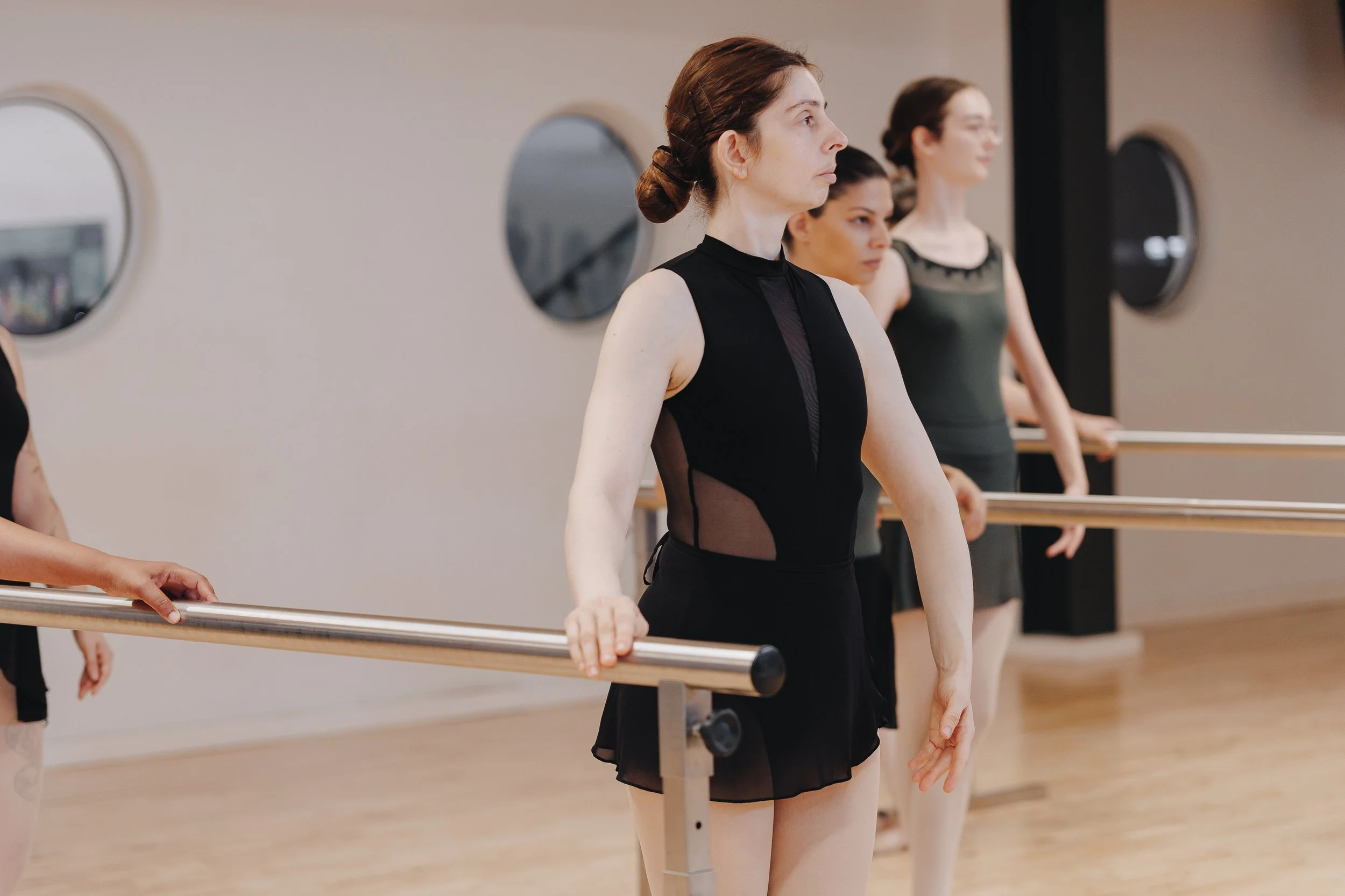
One of the most common complaints among adults is simply feeling stiff and uncomfortable. Long hours sitting at a desk can leave the back, neck and shoulders feeling tight. We become used to certain positions without necessarily noticing how much time we spend in them. Ballet asks us to pay attention. Where is my weight? Are my shoulders tense? Am I standing evenly on both feet? What is my pelvis doing? Can I move my head, arms and spine without taking unnecessary tension elsewhere? Over time, that awareness can become something we carry outside the class.The goal isn't to walk around looking like a ballerina all day. It is to become more aware of how we stand, sit and move.
When your body feels weaker than it used to
Another common frustration is losing strength without really noticing it. Perhaps stairs feel harder, standing on one leg feels surprisingly difficult, or you realise that your legs tire more quickly than they used to. Ballet is full of small movements that demand strength and control. Rising onto demi-pointe, holding a position, moving slowly through a tendu or controlling the landing of a movement all require the body to work.
When balance and coordination start to disappear
Balance is something we rarely think about until it becomes difficult. Ballet gives us countless opportunities to practise it. We shift our weight, stand on one leg, change direction and coordinate our arms and legs while keeping the rest of the body organised. And there is another benefit that adults often mention: concentration. Learning a combination means remembering, listening, anticipating and responding. Your body and your mind have to work together. For someone who spends most of the day doing repetitive tasks at a desk, that can be a refreshing kind of challenge.
When you feel disconnected from your body
This is perhaps one of the less obvious difficulties of adult life. We can become very good at thinking, working, organising and looking after everyone else, while paying surprisingly little attention to how our own bodies feel. Ballet changes that. You notice your feet, balance, posture, and breathing pattern. The difference between one side and the other. You begin to recognise tension before it becomes uncomfortable. And, most importantly, you start to notice what your body can do. That can be particularly valuable for adults who have become hesitant about movement because of previous injuries and pain, or simply years without regular exercise.
What about back, knee or other pain?
This is where I would always encourage caution: if you have persistent pain, an injury or a medical condition, ballet should not replace advice from your doctor or physiotherapist. And Pain, however, does not necessarily mean that movement should disappear from your life. For many people, the answer is not doing more, harder or faster. It is learning to move better, building strength gradually and understanding what your particular body needs. That is one of the reasons adult ballet should be adaptable. Your turnout does not have to look like somebody else's. Your flexibility does not have to match your teacher's. You do not need to force a position because you think that is what ballet is supposed to look like. You start where you are and you build from there.
A Studio B student's experience
«When you’re an adult in ballet, beginner or starting all over again after years of stopping, not many teachers will take you or even put their faith in you. We begin thinking that maybe we are too late to dance, that we’re not worth the time. But Inês helps us believe in ourselves because she believes we can do it. She’s patient, kind and mindful of our limits, and at the same time pushes us to try to go the distance. In six months I evolved in ways I thought I never could, physically and mentally. Ballet has helped me cope with my stress, boosted my confidence and improved my posture. » - Teresa
You can read what our community says about STUDIO B here.
The body you have now
I think this is one of the most important differences between adult ballet and the way many people imagine ballet. You do not have to recreate the body you had at 18. There is no need to be extremely flexible. Coordination is something you gain over time, not a prerequisite to take a class. Certainly, you do not have to look like a professional dancer because this is supposed to be fun, not work - I bet you have plenty of that already going on!
You just need to be willing to move and accept the position of a learner - meaning you will not know things until you learn them (it’s that simple to say but tricky to do).
Perhaps you want to feel stronger, improve your balance, better your posture. You might want to feel less stiff after sitting at your desk all day. You want to regain confidence in your body after an injury. Or perhaps you simply want an hour in your week when you are completely focused on yourself. Ballet can give you all of those things, by helping you develop a body that feels more capable and more enjoyable to live in, and I think that is a very good reason to dance!
Miss Inês Director and Head Teacher, Studio B Ballet Academy
FAQs
Can ballet help with back pain? It can support strength, mobility and body awareness, which may make movement more comfortable. Ballet is not a treatment for persistent pain.
Can ballet improve posture? Yes. Ballet develops awareness of alignment, posture and movement control.
Can ballet improve strength, balance and flexibility? Yes. Regular practice can develop lower-body strength, balance, coordination and mobility.
Can I start ballet as an adult? Absolutely. You can start ballet in your 20s, 30s, 40s, 50s or beyond, with no previous experience.
Can I do ballet if I have an injury? Possibly, depending on your condition. Always seek appropriate medical advice and let your teacher know about any limitations.
Can I learn ballet online? Yes. Adult ballet can be taught effectively online, with exercises adapted to your space, level and needs. Learn more here.
What are the main benefits of adult ballet? Ballet can help you build strength, balance, mobility, coordination, posture and body awareness - while giving you a rewarding way to move.